
Introduction
In the world of distance education, “distance” is often misunderstood. We tend to think of it strictly in terms of geography—the physical miles between a teacher and a student. However, Michael G. Moore’s Transactional Distance Theory (TDT) argues that distance is much more than geography. It is a pedagogical and psychological phenomenon.
“Transactional distance” refers to the cognitive and communicative space that exists between instructors and learners. This space can lead to potential misunderstandings or feelings of isolation, but it can be bridged through specific instructional designs.
As educators, understanding this theory is crucial for designing online courses that don’t just deliver content, but actually connect.
The Three Pillars of Transactional Distance
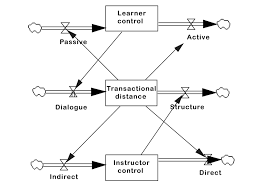
Moore identifies three key clusters of variables that determine the extent of transactional distance: Dialogue, Structure, and Learner Autonomy.
1. Dialogue (Interaction)
This isn’t just about the frequency of communication, but the quality. Dialogue refers to the positive interactions between the teacher and the learner (and among learners themselves).
- High Dialogue: Reduces transactional distance. The learner feels supported and connected.
- Low Dialogue: Increases transactional distance. The learner may feel isolated.
2. Structure (Course Design)
Structure refers to the rigidity or flexibility of the course’s educational objectives, teaching strategies, and evaluation methods.
- High Structure: A rigid course where every step is pre-determined (e.g., a self-paced video course with no instructor feedback) has high transactional distance. It allows for little deviation or personalization.
- Low Structure: A flexible course that adapts to individual student needs has low transactional distance.
3. Learner Autonomy
This is the bridge the learner must build themselves. Learner autonomy is the extent to which the learner decides what, how, and how much to learn.
- The Relationship: There is a direct relationship between distance and autonomy. As transactional distance increases (High Structure, Low Dialogue), the learner must exercise greater autonomy to succeed. Conversely, students with low autonomy require lower transactional distance (more human guidance).
The Inverse Relationship
The core of Moore’s theory can be visualized as an inverse relationship between structure and dialogue:
More Structure + Less Dialogue = High Transactional Distance (Requires a highly autonomous, self-directed learner)
Less Structure + More Dialogue = Low Transactional Distance (Better for learners who need guidance and support)
Why This Matters Today
In the era of Zoom, LMS platforms (like Canvas or Moodle), and AI, Moore’s theory is more relevant than ever.
- Synchronous vs. Asynchronous: Live classes (Synchronous) naturally offer higher dialogue, reducing distance. Self-paced modules (Asynchronous) often rely on high structure, requiring us to build in “artificial” dialogue points (like forums or peer reviews) to keep learners engaged.
- The Role of AI: Artificial Intelligence is changing the equation. AI tutors can provide “Dialogue” at scale, potentially lowering transactional distance in high-structure courses where a human teacher cannot answer every student instantly.
Conclusion
Transactional Distance Theory reminds us that teaching is a social act, even when mediated by technology. By balancing structure with meaningful dialogue, we can close the psychological gap and create learning environments where students feel seen, heard, and supported—regardless of how many miles away they are.
Further Reading
- Moore, M. G. (1993). Theory of transactional distance. In D. Keegan (Ed.), Theoretical Principles of Distance Education (pp. 22-38). Routledge.
- Moore, M. G. (1997). Theory of transactional distance. In Theoretical Principles of Distance Education.